PhD Students

Fidel Alvarez Murphy
PhD Student · Collective phenomena in proliferating active matter
My research studies collective phenomena in proliferating active matter systems, including tissues and biofilms. I use coarse-grained discrete models that account for cell proliferation and elastomechanical interactions. I connect them to macroscopic continuum descriptions based on hydrodynamic and transport equations. Within this multiscale framework, I investigate how the interplay between growth and mechanics generates emergent ordering, patterns, and instabilities, while also shaping strain competition and the stochastic transmission of genetic information, including mutations, in expanding populations. By combining mechanical modeling with stochastic and statistical approaches, my work aims to reveal how deterministic constraints and microscopic fluctuations jointly govern the organization and evolution of collective biological systems.
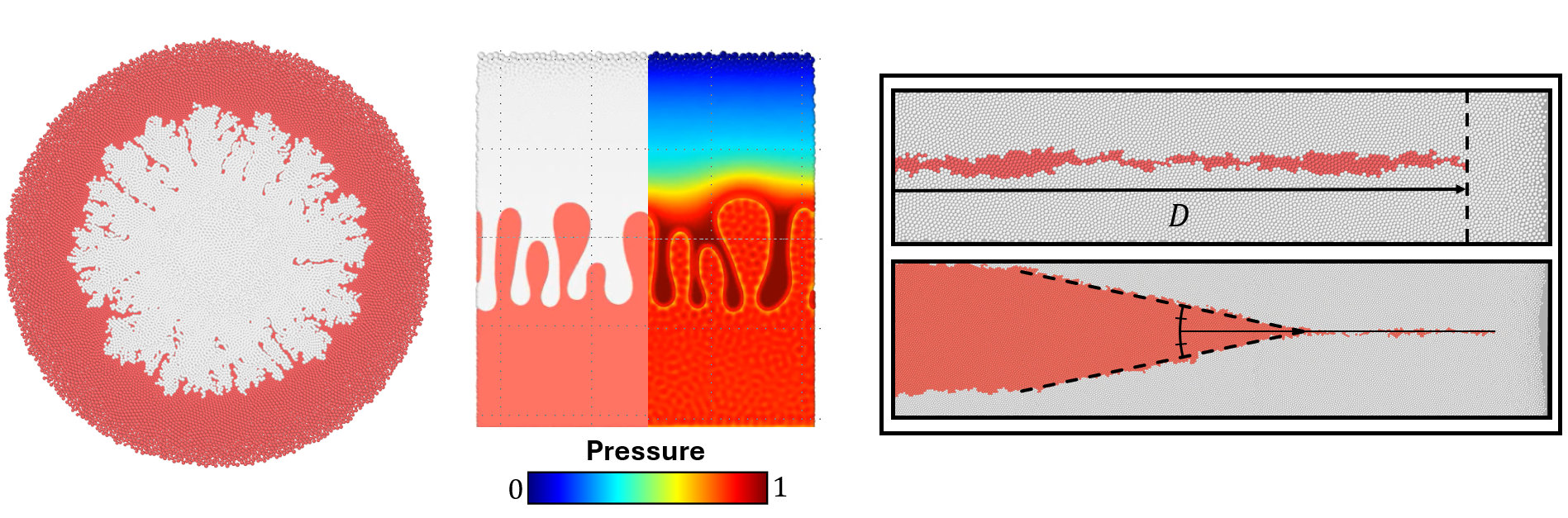
Fidel Alvarez Murphy — research figure
Christian Calderón
Christian Calderón
PhD Student · Active rigid networks and collective motion
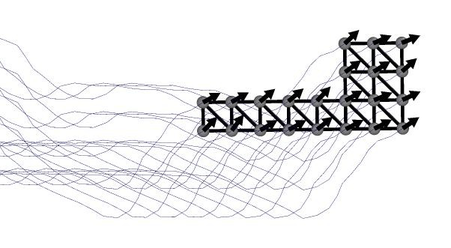
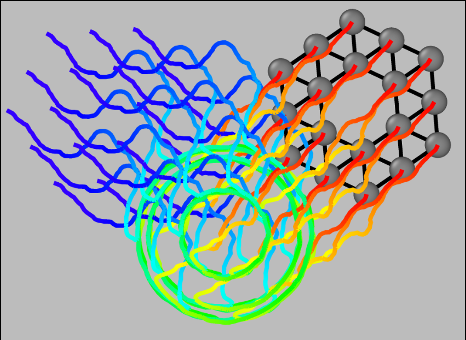
My research focuses on rigid networks of self-propelled active matter units subject to self-alignment interactions. I study how collective behaviors emerge from the interplay between local activity, alignment rules, and the mechanical constraints imposed by the network topology. A central question is whether the geometry of the network itself selects privileged directions of collective translation — that is, how structural and topological features shape and constrain the macroscopic motility patterns that arise. By combining numerical simulations with analytical approaches, I aim to establish connections between microscopic propulsion and alignment mechanisms and the emergent large-scale dynamics of active elastic networks.
Christian — research figure
Leonardo Leiva
PhD Student · Amorphous materials and active matter
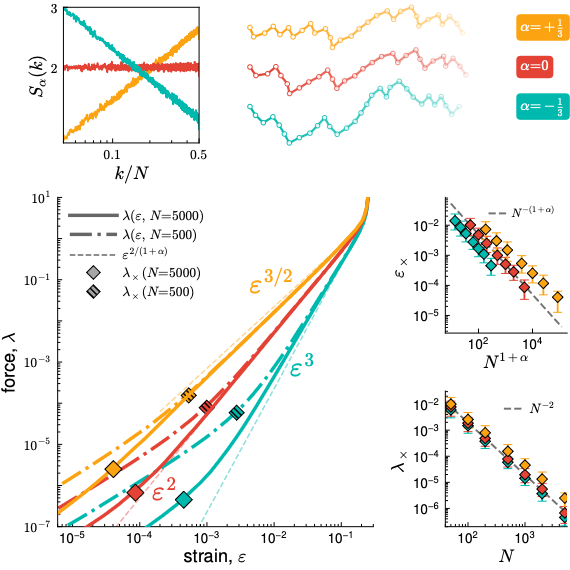
My research focuses on amorphous materials and active matter, exploring how collective phenomena emerge in dense systems across scales. I connect rheology and avalanche statistics through scaling relations to better understand the dynamics and organization of these complex systems.
Daniel Rosenblatt
Daniel Rosenblatt
PhD Student · Active matter and collective phenomena
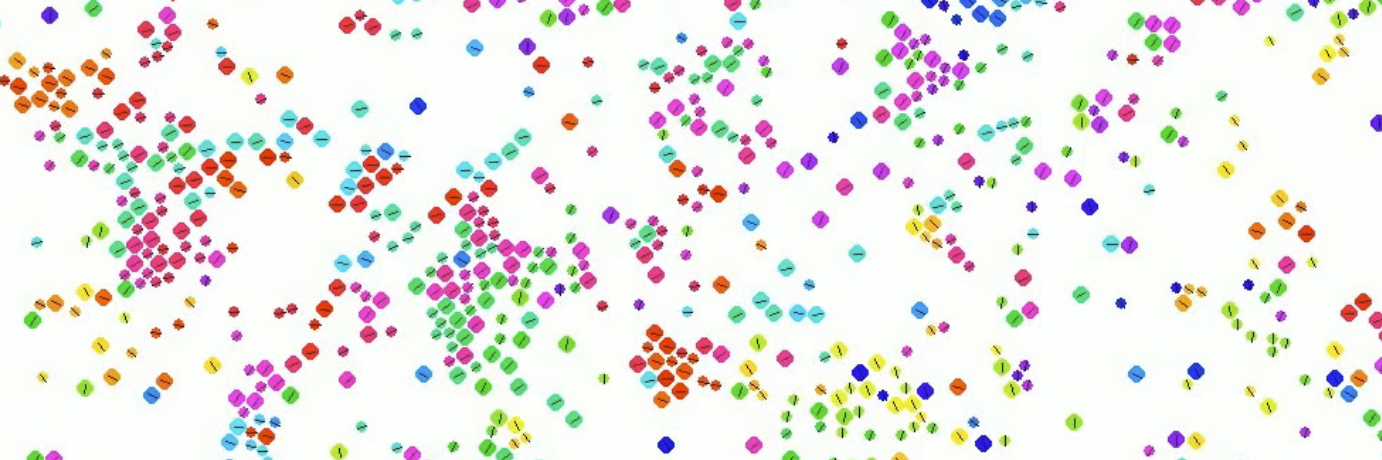
My research explores how collections of self-propelled particles organize into large-scale structures and phases. Starting from the interactions between individual particles, I develop theoretical frameworks that connect microscopic dynamics to the emergent macroscopic behavior of these systems. A central focus is understanding how self-propulsion, density, and alignment interactions combine to produce phenomena like motility-induced phase separation and orientational ordering, and how these compete or cooperate across different symmetry classes. More broadly, my work tries to understand what microscopic rules determine where and how active matter systems transition between disordered and ordered states — a question that sits at the intersection of statistical mechanics, soft matter, and the physics of living systems.
Daniel Rosenblatt — research figure

Master's Students

Matías Cubillos
Matías Cubillos
Master's Student · Path integral methods in financial mathematics
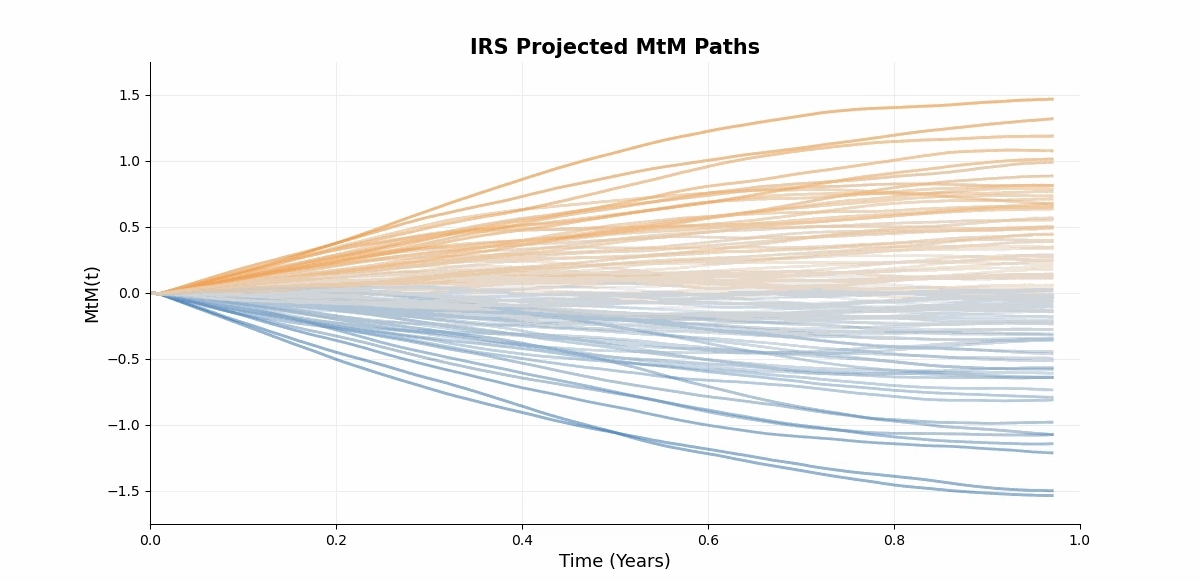
My work develops a path integral formalism for pricing derivatives and other financial instruments. By adapting techniques from theoretical physics, I aim to capture path-dependent dynamics and derive analytical approximations that shed light on valuation adjustments (XVA), such as funding, credit, and collateral costs.
Matías Cubillos — research figure

Associate Researchers

Claudio Hernández-López
Associate Researcher · Active solids, self-organization, and biological decision-making
I began working with Gustavo during my bachelor's thesis, which introduced me to the world of active matter. We studied active solids — systems of self-propelled agents with fixed neighbors coupled by spring-like interactions — in collaboration with researchers at the ESPCI in Paris and the UvA in Amsterdam. When confinement is present, we found that the ratio between activity and elasticity controls a transition between a frozen state and a collective actuation state; a minimal theoretical model connected the system geometry to the onset of non-trivial dynamics and to the elastic modes that become excited. In the unconfined, rigid-spring limit, the behavior can be captured by a Landau free energy functional depending on the structure of the zero modes, which predicts which modes are activated and their amplitudes as a function of noise, revealing a continuous order-disorder phase transition at a well-defined critical noise. My current interests span self-organization and decision-making in biological and soft matter systems, combining tools from statistical physics, continuum mechanics, biochemistry, and information theory.
Claudio Hernández-López — research figure